Blog Topics
A few times a year, trees across Greater Cincinnati get tested. In January, ice loads the canopy. Then, straight-line winds show up in March, with hail and severe thunderstorms running into late summer. Healthy trees aren’t usually the ones that come down in those storms—it’s the ones with a shifting lean, a crack running down the trunk, or a dead limb from a few summers ago that hasn’t fallen yet. Most signs a tree is dangerous are visible from the ground months prior to anything happening.
Knowing which warning signs matter is the hardest part. Some defects are cosmetic, while others point to a tree that’s far more likely to fail. Understanding the difference can help you decide whether the tree should be monitored, pruned, or inspected by a Certified Arborist before it becomes a safety hazard.
Key Takeaways
- Not every tree defect is dangerous, but warning signs over a home, driveway, or other frequently used area deserve immediate attention.
- Where the defect is located helps predict how a tree is most likely to fail, whether that’s uprooting, trunk failure, or falling limbs.
- Heavy rain, saturated soil, ice, and strong winds often expose problems that were already developing—not create them overnight.
- A dangerous-looking tree can sometimes be managed through pruning, cabling, or routine monitoring by a Certified Arborist.
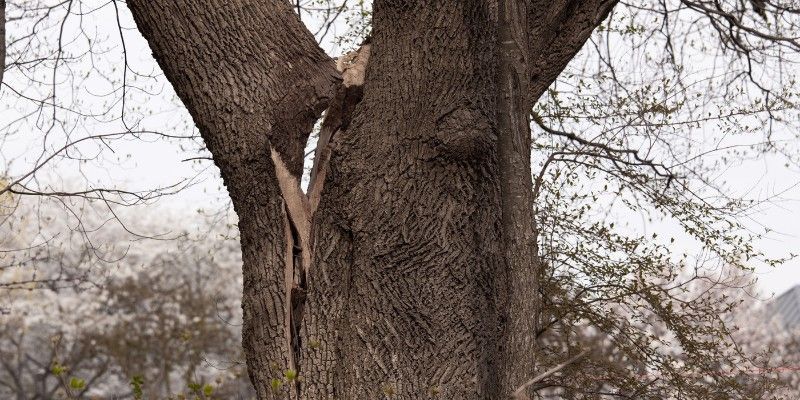
A partially broken limb like this holds stored tension and can release without warning, so it should be handled by a professional, not pulled down.
What Actually Makes a Tree Dangerous?
A tree becomes dangerous when a structural defect has the potential to hit something valuable, like a home, driveway, vehicle, or place where people spend time. Arborists evaluate tree risk by considering three factors:
- The defect itself (such as decay, a crack, or dead wood)
- What the tree could hit if it fails
- How likely that failure is
In Greater Cincinnati, that likelihood is often higher than average because trees are repeatedly stressed by ice, strong winds, and saturated soil. Those weather events don’t usually create problems overnight—they expose weaknesses that have been developing for months or even years.
As you read through the warning signs below, keep two questions in mind:
- What could this tree or branch hit if it failed?
- Has the defect changed since the last time I noticed it?
A defect that’s growing, spreading, or shifting after storms deserves much more attention than one that has remained stable over time.
What Do Problems at the Base and Roots Mean?
Problems at the base and roots can predict the most consequential failure a tree can have: the entire thing coming down at once.
Is a Leaning Tree Dangerous?
The problem isn’t a lean by itself; a tree that grew at an angle built wood to support it. A lean that’s changed recently or gotten worse over time should be cause for alarm, and you’ll first notice it in the ground:
- Disturbed Soil : Cracking or mounding on the side opposite the lean
- Newly Exposed Roots : Surface roots that weren’t visible last year
- A Shifted Angle: A lean that moved noticeably after a storm
The exact angle isn’t as important as whether or not the lean is new or the ground is moving with it. A recent lean combined with soil disturbance means you should call now to get it looked at. If your tree has always had a lean and it’s angled away from anything it could hit, you can monitor it.
Are Mushrooms Growing Around a Tree a Warning Sign?
Mushrooms or shelf-like fungi growing at the base of a tree often indicate decay in the roots or lower trunk. While not every mushroom is a sign of structural failure, fungal growth around the base deserves attention because the decay is often hidden below the surface.
Pay closer attention if you notice:
- Mushrooms or conks growing directly from the trunk flare or exposed roots.
- New fungal growth appearing after wet weather year after year.
- Other warning signs, such as a leaning trunk, exposed roots, or thinning canopy.
If fungal growth appears on a tree that could strike a home, driveway, or other valuable target, schedule an inspection to determine whether decay has affected the tree’s stability.
STORMS REVEAL WEAKNESSES: Heavy rain doesn’t usually cause healthy trees to fail. Instead, saturated soil reduces the roots’ ability to hold a weakened tree in place. That’s why trees with existing root problems are more likely to uproot during or shortly after periods of heavy rain and high winds.
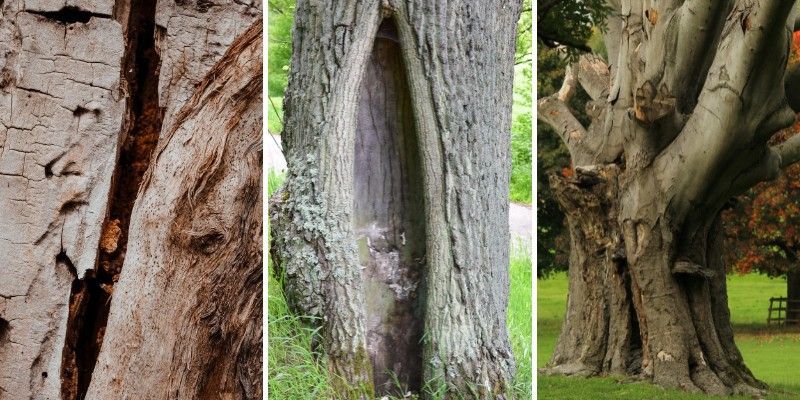
Trunk cracks and cavities are easy to spot at eye level but hard to judge, since what matters is how much sound wood remains around the opening.
Which Trunk Problems Are Structural?
Cracks, cavities, and tight unions are structural issues in the trunk, and all three point to the same failure: the stem snapping while the root system stays where it is.
Cracks and Separating Bark
Deep vertical splits compromise the core of the trunk, the wood that resists bending under wind and snow load:
- A Single Vertical Crack : A real defect, especially if it appears to be deepening
- Cracks on Opposite Sides : The worst case scenario, since the stem has lost integrity along two planes
- Bark Peeling Away From Wood : Usually a sign the tissue underneath has died
Not every crack means a tree is about to fail, but deep cracks and separating bark shouldn’t be ignored. If the crack appears to be widening, extends deep into the trunk, or is on a tree that could strike a home, driveway, or other occupied area, schedule an inspection with a Certified Arborist as soon as possible.
Cavities and Cankers
A cavity isn’t immediately disqualifying, since what’s important is the sound wood left around the opening. Three things raise the level of concern:
- Circumference: Sunken or dead areas wrapping a large share of the trunk
- Origin: Old improper pruning cuts that never closed over
- Combination: A cavity paired with a crack, which is worse than either one alone
Don’t judge a tree’s safety by the size of the opening alone. A cavity may only affect the outer bark—or it may extend deep into the structural wood that supports the tree. If the cavity is on a mature tree that could strike a home, driveway, or other valuable target, have it evaluated by a Certified Arborist.
Codominant Stems and Tight V-Shaped Unions
Codominant stems are two main trunks that grow from the same point. Many trees have them without issue, but the shape of the attachment determines whether it’s strong or prone to splitting.
- Wide, U-Shaped Attachment: A broad connection where the trunks have grown together with strong, supporting wood. These unions are generally much more stable.
- Narrow, V-Shaped Attachment: A tight angle where bark becomes trapped between the stems instead of solid wood forming. These weak unions are more likely to split under the weight of ice, wind, or a heavy canopy.
- Cracks or Separation: If you can see a crack forming where the two trunks meet, or the stems appear to be pulling apart, have the tree inspected as soon as possible.
Many trees with codominant stems don’t need to be removed. If the union is weak but otherwise healthy, a Certified Arborist may recommend cabling or pruning to reduce the likelihood of failure.
What Do Dead and Hanging Branches Mean?
Dead branches are one of the easiest warning signs to spot—and one of the most common reasons trees cause property damage. While small twigs naturally die and fall over time, large dead limbs can break without warning, especially during high winds, ice storms, or even on calm days.
How to Spot Dangerous Dead Branches
Look for branches that have one or more of these signs:
- No Leaves: A branch remains bare while the rest of the tree has healthy foliage.
- Brittle Wood: Dead branches snap easily instead of bending.
- Peeling Bark: Bark is falling off individual limbs, exposing dry wood underneath.
- Repeated Limb Drop: The tree regularly sheds branches, even without severe weather.
- Standing Dead Ash Trees: Ash trees killed by emerald ash borer become extremely brittle and can lose large limbs—or fail entirely—with little warning.
The greatest concern is where the branch is located. Large dead limbs hanging over a roof, driveway, sidewalk, play area, or parking lot should be removed before they fall on their own.
When a Broken Branch Is an Emergency
A branch that’s broken but still hanging in the canopy—often called a widow maker—should be treated as an immediate hazard. These limbs can fall without additional wind or warning.
If you see a hanging branch:
- Stay out from underneath it.
- Don’t try to shake or pull it down yourself.
- If it’s touching or close to a power line, stay away and contact your utility company immediately.
- Otherwise, arrange for prompt removal before the limb falls on its own.
Does a Potentially Dangerous Tree Always Need to Be Removed?
Seeing a crack, cavity, lean, or dead limbs doesn’t automatically mean a tree needs to be removed. Many structural defects can be managed safely with pruning, cabling, or ongoing monitoring. The goal of an arborist inspection is to determine how much risk the tree actually poses—and what can be done to reduce it.
During an inspection, an ISA Certified Arborist evaluates the tree’s overall structure, root system, and the likelihood of failure. They’ll also consider what the tree could strike if it fell, since the same defect carries very different levels of risk depending on its location.
Most inspections end with one of four recommendations:
- Prune : Remove deadwood, reduce the weight on overextended limbs, or correct structural issues that increase the risk of failure.
- Monitor: Document the defect and re-evaluate the tree over time when the risk is currently low or stable.
- Cable or Brace : Install support systems to strengthen weak branch unions or codominant stems on otherwise healthy trees. These systems reduce stress but require periodic inspections.
- Remove : Recommend removal only when the tree has significant structural defects, a high likelihood of failure, and the potential to damage people or property.
Frequently Asked Questions About Dangerous Trees
Do dangerous trees always give a warning before they fall?
No. A lean, spreading crack, or basal decay usually builds over months, but a heavy dead limb or a hung-up branch can drop on a calm, hot afternoon with no warning—which is why quiet days aren’t automatically risk-free.
Should I remove a tree that’s leaning toward my house?
Not necessarily. Many trees naturally grow at an angle and remain stable for decades. What matters is whether the lean is new, increasing, or accompanied by other warning signs like cracked soil, exposed roots, or a trunk that shifted after a storm. Those changes can indicate the root system is failing and the tree should be inspected promptly.
Will it help if I clear the mushrooms off the base of my tree?
No. The mushroom is only the fruiting body; the fungus is already inside the wood, decaying it. Scraping off what shows does nothing to the decay, and it hides the one symptom that tells an arborist how long the problem has been developing.
Why can’t I just pull down a hung-up limb myself?
A widow maker holds stored tension and can release the instant it’s disturbed, dropping onto whoever pulled the rope. They cause a large share of felling injuries, which is why removal is a rigging job, not a tug-of-war.
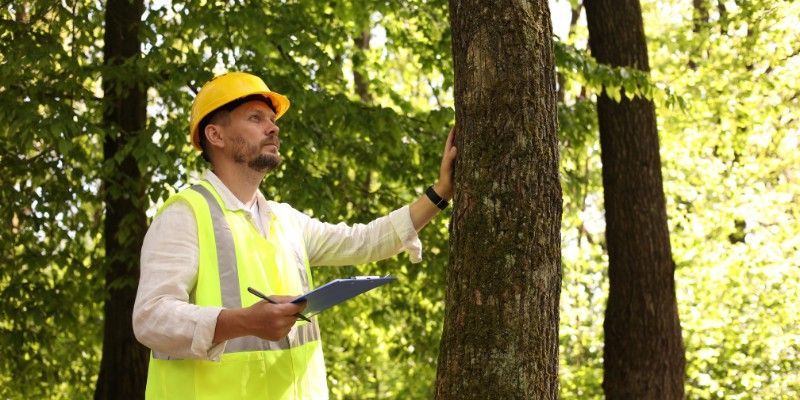
An arborist’s inspection reveals what a ground-level look can’t, including how far decay reaches into the root collar.
Have Priority Tree Assess Your Tree Before the Next Storm
Most dangerous trees don’t fail without warning. Leaning trunks, dead limbs, cracks, cavities, and root problems often develop months—or even years—before a tree comes down. Recognizing those signs early gives you more options, whether that’s pruning, cabling, monitoring, or, when necessary, removal.
If you’ve noticed one or more of these warning signs on your property, Priority Tree’s ISA Certified Arborists can evaluate the tree, explain the level of risk, and recommend the right solution to help protect your trees. Call us today at 513-998-7136 or request an estimate online.
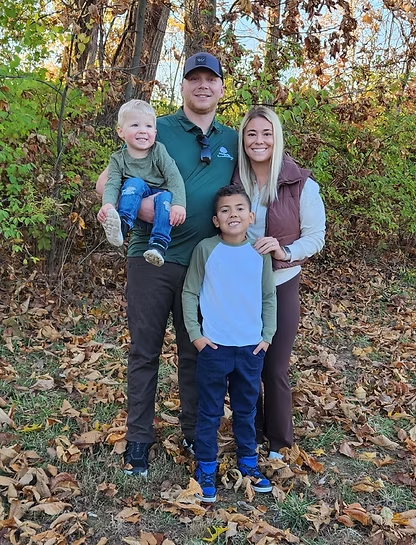
Andrew Wilson
Andrew is the owner of Priority Tree and an ISA Certified Arborist with years of residential, commercial, and disaster-response tree care experience. His background combines hands-on expertise with a strong focus on leadership, professionalism, and a commitment to quality and customer satisfaction.
Our Articles
Fall Tree Care in Cincinnati: 5 Things to Do Before Winter
Andrew Wilson | September 24, 2026
Get your Cincinnati trees ready for winter with practical fall tips for watering, mulching, soil care, pruning, and spotting damage before snow and ice.
What Does an Arborist Look for During a Tree Evaluation in Cincinnati?
Andrew Wilson | August 21, 2026
A declining tree doesn’t always need to come down. Learn what a Cincinnati tree evaluation checks and how an arborist determines what should happen next.
What Does Tree Removal Look Like on a Hillside Property in Cincinnati?
Andrew Wilson | July 31, 2026
See what the tree removal process actually looks like on a sloped Cincinnati lot in Anderson Township and Mt. Washington, from crew arrival to final cleanup.